
Buying a used car feels simple on the surface. You check the condition, take a test drive, bargain a little, and close the deal. But somewhere between the handshake and the paperwork, one confusing term quietly shows up — used car GST rate.
Most people don’t really understand it. Some think GST doesn’t apply at all. Others assume it’s the same as new cars. A few only find out after paying more than expected.
Let’s clear the confusion. Slowly. Honestly. Without jargon.
What Is the Used Car GST Rate?
When you buy a used car in India, GST is not charged the same way as on a new car. That’s the first thing to know.
For new cars, GST is applied on the full vehicle price.
For used cars, GST applies only on the margin.
That means the tax is calculated on the difference between the selling price and the purchase price, not the full value.
Sounds fair, right? It usually is.
But the details matter.
How the Used Car GST Rate Actually Works
Here’s the simple version.
If a registered dealer sells you a used car, GST is applied like this:
-
12% GST for small petrol or diesel cars
-
18% GST for bigger or luxury cars
But here’s the part most people miss.
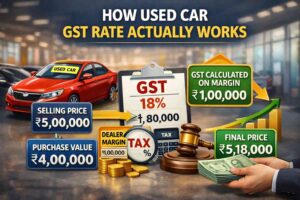
The GST is charged only on the profit margin, not the total car value.
Example
A dealer buys a car for ₹4,00,000
Later sells it for ₹4,50,000
The GST applies only on ₹50,000, not on ₹4.5 lakh.
So the tax is much lower than people assume.
This rule exists to avoid double taxation since GST was already paid when the car was first sold as new.
When Is GST Not Charged on a Used Car?
This surprises many buyers.
If you’re buying a used car from an individual seller, not a dealer, GST does not apply at all.
That means:
-
No GST invoice
-
No GST component in the price
-
Just transfer fees and registration charges
This is why private sales often look cheaper.
But there’s a catch.
You don’t get dealer-level paperwork, warranty, or legal safety net. So you save on tax but take on more risk.
Used Car GST Rate for Different Vehicle Types
Here’s a simple breakdown most people search for.
-
Petrol cars (engine up to 1200cc)
GST rate: 12% -
Diesel cars (engine up to 1500cc)
GST rate: 12% -
Larger cars and SUVs
GST rate: 18% -
Electric used cars
GST rate: 12%
Again, this applies only to the margin made by the seller, not the full car price.
Why the Used Car GST Rate Confuses Buyers
Because nobody explains it properly.
Dealers often quote a “final price” without showing how much GST is included. Buyers see a number and assume it’s fixed.
Sometimes GST is already baked into the price. Sometimes it’s added later.
If you don’t ask, you won’t know.
So ask clearly:
-
Is GST included in this price?
-
How much GST am I paying?
-
Is it calculated on margin or full value?
These questions alone can save you thousands.
Used Car GST Rate and Registration Transfer
This part is often misunderstood.
GST has nothing to do with RTO transfer fees.
Even if GST is zero, you still pay:
-
Ownership transfer fee
-
Road tax difference (in some states)
-
RC update charges
These are government charges, not taxes on the sale.
Many buyers mix these up and assume GST is being charged again. It’s not.
What About Used Cars Bought from Online Platforms?
Platforms like Cars24, Spinny, and others usually include GST in their listed price.
You’re not paying extra on top of that.
It’s already part of the deal.
Still, it’s smart to ask for a clear invoice showing:
-
Vehicle price
-
GST amount
-
Registration charges
Transparency matters, especially with big purchases.
Does GST Change Based on Car Age?
No.
The used car GST rate does not change based on how old the car is.
A 2-year-old car and a 7-year-old car fall under the same GST rules.
What changes is the margin. Older cars usually have lower resale value, so the GST amount becomes smaller naturally.
Common Myths Around Used Car GST Rate
Let’s clear a few things people often get wrong.
-
“GST is charged twice on the same car”
Not true. GST is applied only on value addition. -
“Used cars don’t have any tax”
Wrong. They do, but it’s limited. -
“Private sellers must charge GST”
Not at all. Individuals don’t collect GST. -
“GST depends on car brand”
No. It depends on engine size and category.
Once you know this, pricing starts making sense.
How the Used Car GST Rate Affects Your Budget
This part matters if you’re planning your spend.
If you buy from a dealer:
-
Expect a slightly higher price
-
But better paperwork
-
Sometimes warranty
-
Cleaner ownership transfer
If you buy from an individual:
-
Lower cost
-
No GST
-
But more responsibility on you
There’s no right or wrong choice. It depends on your comfort level.
A Quick Real-Life Example
I once helped a friend buy a used hatchback. The dealer quoted ₹5.2 lakh. It sounded high.
After asking for the breakdown, we found:
-
Base car value: ₹4.8 lakh
-
GST on margin: ₹12,000
-
Handling charges: rest
Once everything was clear, the price made sense. But without asking, it felt inflated.
That’s how clarity changes perception.
Why Knowing the Used Car GST Rate Matters
Because it helps you:
-
Negotiate better
-
Avoid overpaying
-
Understand the bill
-
Spot hidden charges
Most people don’t question numbers. You should.
Quick Checklist Before You Buy
-
Ask if GST is included
-
Ask how GST is calculated
-
Check if seller is a dealer or individual
-
Ask for a proper invoice
-
Compare final price with market value
Simple steps. Big difference.
Final Thoughts
The used car GST rate isn’t complicated once you see how it works. It’s just rarely explained in plain language.
You don’t need to be a tax expert.
You just need to ask the right questions.
And once you do, buying a used car feels a lot less stressful.
If you’re planning to buy one soon, keep this information handy. It might save you more than you expect.